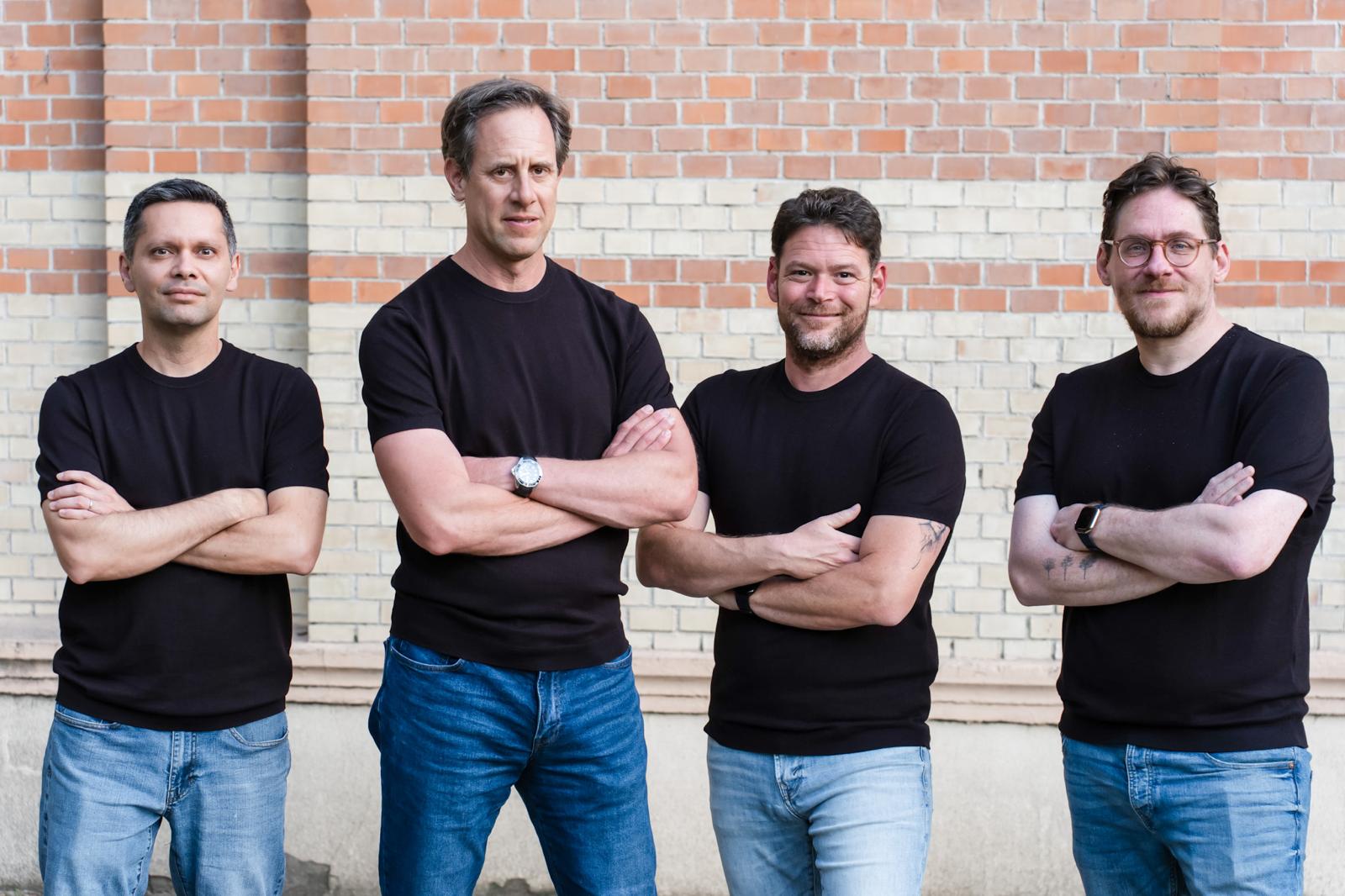
Built by operators
Our team helped scale Rapyd to $1B+ in revenue across 50+ countries — overseeing 100+ partner integrations, compliance across dozens of jurisdictions, and the operational complexity that came with it.
Our investors













Cordant exists because modern financial infrastructure was never designed to operate with shared context
Money moves across systems that do not talk to one another. Teams stay reactive in an industry that only ever sees what already happened. Context is lost as information passes across systems, functions, counterparties, and entities. Policies drift from reality in businesses where money moves continuously across increasingly complex operational environments.
We know this because we lived it firsthand.
Before founding Cordant, our team helped build one of the world's largest global fintech platforms at Rapyd. We saw what happens as financial infrastructure scales across countries, payment methods, banks, processors, compliance systems, treasury operations, partners, and regulatory regimes.
At global scale, operational fragmentation becomes one of the defining constraints on growth.
The hard part was never moving money.
It was understanding what was happening across hundreds of systems and counterparties at once. Coordinating decisions across compliance, treasury, operations, finance, support, and external partners. Reconstructing the truth from fragmented signals spread across disconnected systems.
As infrastructure expands, visibility breaks down, teams turn reactive, and every operational issue becomes a cross-functional investigation.
For years the industry answered this with more integrations, more dashboards, more reporting layers, more systems of record. But the problem was never a shortage of software. The problem is fragmentation itself.
Every bank, PSP, issuer processor, program manager, fintech, compliance vendor, treasury system, blockchain network, and operational platform speaks its own language. Every workflow creates another silo. Every handoff creates another blind spot.
And the complexity is accelerating. Stablecoins, tokenized deposits, real-time payments, embedded finance, and globally distributed financial systems are forcing institutions to coordinate across more rails, more entities, and more operational environments than ever before.
The financial system has become deeply interconnected. Operationally, it remains fragmented.
Cordant is being built to close that gap.
We are building the connective operational fabric for modern financial infrastructure: a shared context layer that sits above existing systems and unifies operational data across fragmented environments, so institutions can analyze activity, surface risk, and coordinate decisions in real time.
Consider what this looks like in practice. Revenue that cannot be recognized cleanly because hundreds of pricing schemes are scattered across systems that disagree on what was actually billed. Partnership and program oversight that depends on after-the-fact sampling instead of real-time observability. Compliance obligations — from the regulator, from Visa and Mastercard, from industry-specific regimes like healthcare payments — that become untenable to manage as the number of systems and counterparties each obligation touches keeps growing.
None of these are single-system problems, which is precisely why pointed solutions fall short. A payment is not one event in one system. It is a sequence of states spread across processors, ledgers, banks, schemes, and compliance tooling — auth, capture, settlement, funding, reversal, each recorded differently in a different place. A tool that owns one of those systems can only ever see its own slice. The failure almost never happens inside a system; it happens in the seams between them, where no single product is looking. Buying another point solution adds one more system that speaks its own language — and one more blind spot.
Cordant connects to the systems already in place to create a single operational reality. We normalize fragmented activity into a consistent structure, correlate signals across systems and counterparties, and continuously evaluate behavior against operating policies and governance frameworks. Every decision carries its own evidence — the context behind it, the policy it was measured against, and the provenance to prove it.
Cordant does not move the money. It makes sure every system agrees on what happened — before, during, and after the money moves.
That distinction matters, because the coordination challenge no longer stops at the edge of a single company. The next generation of financial infrastructure requires institutions to coordinate not only internally, but across banks, fintechs, payment providers, custodians, compliance organizations, and digital asset ecosystems.
Risk is no longer isolated. Operations are no longer isolated. Trust can no longer be isolated.
The institutions that succeed will be the ones able to operate with shared context across fragmented ecosystems. That is why Cordant is not simply operational software. It is infrastructure for coordinated financial operations across organizational boundaries.
This becomes even more important in the era of AI. AI without context produces noise. AI without governance produces risk. And AI confined to a single system cannot touch the highest-value problems in finance, because those problems inherently cross systems, functions, and entities. Cordant is the governed context and control layer that makes AI usable on exactly that surface — bound by policy, grounded in evidence, accountable by design.
One of the strongest validations of this vision is who is choosing to build alongside us. Our design partners span banks, PSPs, digital asset infrastructure providers, fintech platforms, compliance teams, and treasury organizations. On the surface they look like very different institutions with very different problems.
They are not.
A bank chasing a payment exception, a PSP reconciling a wallet against its ledger, a custodian coordinating a compliance handoff, a treasury team trying to see across its rails — these look like separate problems, but they are the same problem wearing different clothes. Each one is an attempt to reconstruct a single coherent picture from systems that were never built to share one. Each one breaks at the seams between systems, not inside them.
That convergence is not a coincidence. It is evidence that the coordination problem is universal — and that solving it requires a fundamentally different approach to financial infrastructure.
Sound familiar? Let's talk
If your business carries the liability for what happens between systems, we want to hear from you.
Request received
We'll be in touch shortly.
Let's talk
Access is limited. If your business carries the liability for what happens between systems, we want to hear from you.